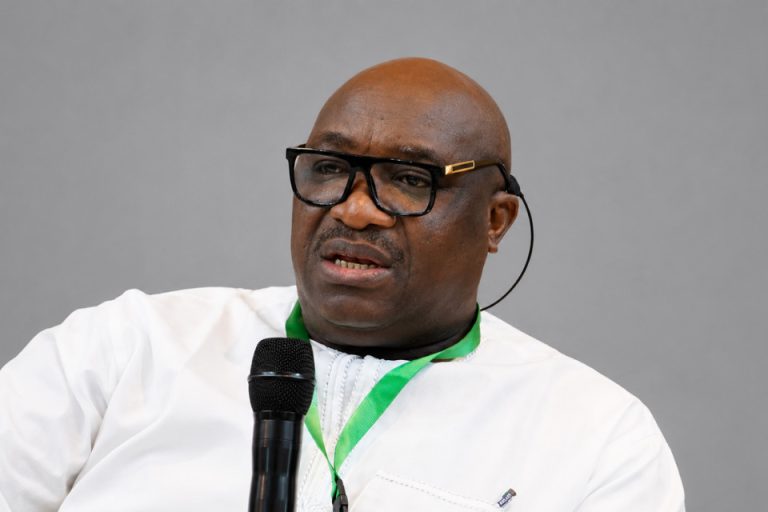
August 8, 2001, witnessed the commercial launch of Global System for Mobile Communications (GSM) services in Nigeria, as the first digital mobile operators ushered in a communications revolution that would fundamentally transform how Nigerians connect, conduct business, access information, and participate in the economy. On the 25th anniversary of that event, the Executive Director of Media Rights Agenda, Mr. Edetaen Ojo, shares some insights on the impact of GSM on Nigeria’s communication landscape in an interview with MRA’s Communications Officer, Idowu Adewale
The emergence of the Global System for Mobile Communications (GSM) services in Nigeria during the administration of President Olusegun Obasanjo was a communications revolution that transformed the country and its digital landscape, according to the Executive Director of Media Rights Agenda (MRA), Mr. Edetaen Ojo, as he recounted the evolution and assessed the impact of mobile telephony in Nigeria over the last 25 years.
Speaking in an interview with MRA’s Communications Officer, Idowu Adewale, on the anniversary of the launch of GSM in August 2001, during which he highlighted the wide-ranging benefits and developments in Nigeria in the last 25 years that are directly traceable to the emergence of GSM, Mr. Ojo argued that few policy decisions in Nigeria have generated such long-term economic and social benefits.
He recalled that “When the first GSM calls were made in August 2001, many Nigerians viewed mobile phones as symbols of wealth, but today they are widely regarded as essential tools of everyday life as children use them for learning, farmers use them to check market prices, doctors use them for telemedicine, journalists use them to report breaking news, entrepreneurs use them to build and operate businesses, and families use them to stay connected across continents,” adding that “25 years after the launch of GSM, Nigeria’s telecommunications revolution stands as one of the country’s greatest public policy success stories.”
Mr. Ojo also highlighted the impact of GSM on journalism and media practice, noting that “few professions have been transformed as dramatically as journalism and media” as news and information gathering, processing, and dissemination have become faster, more efficient, and increasingly participatory.
He recalled that before commercial GSM services officially commenced in Nigeria on August 8, 2001, reporters depended largely on landlines, fax machines, and physical travel for communication activities, including gathering and transmitting stories.
In contrast to that era, he said, “Journalists can now report events in real time and broadcast live from virtually anywhere, while citizens with smartphones often become eyewitness contributors, even providing eyewitness photographs and videos during emergencies, elections, and other public events. Social media platforms, enabled by mobile internet access, have redefined public discourse and expanded opportunities for civic engagement, although they have also introduced new challenges such as misinformation, disinformation, and online harassment, among others.”
Observing that “millions of young persons in Nigeria have no idea what the communications landscape in Nigeria was over 25 years ago,” Mr. Ojo recalled that “before GSM arrived in August 2001, telecommunications in Nigeria was largely the preserve of a privileged few.”
According to him, “Fixed analogue telephone lines, operated mainly by the then Nigerian Telecommunications Limited (NITEL), were scarce, unreliable, and often inaccessible. There were less than 500,000 lines all over the country, serving a population of about 150 million people at that time. Nigeria therefore had one of the lowest telephone penetration rates in the world.”
He said early in 2001, when the Nigerian Communications Commission (NCC) conducted an auction for Digital Mobile Licences, the successful bidders from that exercise, namely MTN Nigeria and Econet Wireless Nigeria, paid what was then a record US$285 million each for their licences.
Mr. Ojo explained that Econet Wireless Nigeria later evolved through several ownership changes to become the current Airtel Nigeria, adding that shortly after that auction exercise, Communications Investments Limited (CIL), which operated as M-Tel, also entered the market.
He said: “By August 2001, when Nigerians began making their first GSM calls, this new communications technology had started dismantling long-standing barriers to communication in Nigeria. Mobile phones, which were previously regarded as luxury items because of their high cost, rapidly became indispensable tools for households and businesses alike. As competition increased, handset prices reduced, network coverage expanded, and mobile services became increasingly affordable.”
Stressing that the communications landscape has accordingly changed dramatically since August 2001, he noted that the latest available subscription data from the NCC showed that the number of active mobile telephone subscriptions in Nigeria as at June 2026 stood at over 192 million lines with a teledensity of 88.67 percent while the number of internet subscriptions on GSM was over 156 million during the same period, with broadband subscription standing at over 123 million with a penetration of 56.79 percent.
Mr. Ojo argued that since 2001, GSM has become a catalyst for economic transformation as it spurred many businesses, with entrepreneurs establishing phone call centres, recharge card distribution businesses, mobile phone retailing, mobile phone repair businesses, telecommunications engineering, tower construction and maintenance, fibre-optic deployment, mobile software development, digital advertising, ride-hailing services, and e-commerce while thousands found employment as mobile phone technicians, tower construction engineers and workers, network engineers, customer service representatives, software developers, and digital service providers.
Noting that entire industries emerged around mobile technology, creating millions of direct and indirect jobs, he said: “A major legacy of GSM is the financial inclusion that it has helped to facilitate. Before mobile connectivity, banking services were largely concentrated in urban centres. Today, smartphones have become portable bank branches in the hands of most Nigerians.”
Mr. Ojo insisted that “Perhaps no sector illustrates GSM’s transformative effect more clearly than financial services. Mobile connectivity laid the foundation for Nigeria’s digital banking revolution. Electronic transfers, mobile banking applications, fintech innovations, and digital payment platforms would not have achieved their current scale without widespread mobile connectivity.”
He said that as a result of the emergence of the technology in the country, millions of Nigerians are able to conduct financial transactions daily using their mobile phones, adding that “most Nigerians can transfer money instantly, pay utility bills, receive salaries, access loans, save and invest, buy insurance, and operate businesses, using only their mobile phones.”
Mr. Ojo observed that the telecommunications sector itself has become one of the pillars of Nigeria’s economy as it consistently contributes a substantial share of the country’s Gross Domestic Product, attracts billions of dollars in investment, and remains one of the fastest-growing sectors with successive generations of mobile technology, which have evolved from 2G voice services to 3G, 4G LTE, and currently 5G, expanding opportunities for innovation, e-commerce, remote work, online education, healthcare delivery, and entertainment, among others.
He contended that GSM has also reshaped governance as Governments at all levels and public institutions are increasingly using mobile platforms to communicate with citizens, deliver public services, disseminate emergency information, register citizens, collect taxes, process identity documents, communicate public health information, facilitate elections, and implement digital identity schemes and social protection programmes.
In addition, he said, civil society organisations have similarly leveraged mobile technology to promote transparency, monitor elections, document human rights abuses, advocate for transparency and human rights, facilitate citizen participation in governance, and promote public accountability.
Mr. Ojo pointed out that besides the pivotal role that mobile telephony played in the advocacy for the passage of the Freedom of Information Bill in Nigeria, since the adoption of the Law, the FOI movement or community has also benefited from digital tools that simplify the submission of requests for information and have been used to expand public awareness of the right to access information.
He said education had also experienced profound changes with mobile internet opening up access to online learning platforms, digital libraries, virtual classrooms, educational videos, and research resources.
According to him, students in many parts of the country now rely on smartphones as their primary gateway to educational content, in addition to the situation during the COVID-19 pandemic when mobile connectivity became essential for sustaining education, business operations, and public communication amid widespread lockdowns.
However, Mr. Ojo admitted that the GSM revolution has not been without challenges, noting that despite remarkable progress and achievements that have been recorded since the emergence of GSM in the country, many issues still need to be addressed, including poor quality of service, dropped calls, service outages, network congestion, inconsistent internet speeds, rural connectivity gaps, the high cost of smartphones, expensive data services, vandalism of telecommunications infrastructure, multiple taxation of operators, unreliable electricity supply increasing operating costs, cybersecurity threats, and digital exclusion among vulnerable populations.
He also identified affordability as a pressing issue, pointing out that although mobile ownership has expanded dramatically, the cost of smartphones and mobile data remains prohibitive for many low-income Nigerians, with the result that the country’s digital divide continues to mirror broader inequalities, leaving some communities with limited access to the educational, economic, and social opportunities enabled by digital connectivity.
Mr. Ojo said security concerns have further complicated the telecommunications landscape as criminals have exploited mobile technology for fraud, kidnapping, cybercrime, and identity theft, prompting regulatory measures such as mandatory SIM registration and the linkage of Subscriber Identification Modules (SIMs) to the National Identification Number (NIN).
He noted that although these initiatives are aimed at strengthening security, they have also generated important debates about privacy, data protection, surveillance, and the balance between security and fundamental rights.
Saying that Nigeria’s telecommunications journey is clearly not finished given these persistent challenges which remain, he predicted that how Nigeria addresses the issues will determine whether the country will be able to fully realise the promise of its digital future.
He suggested that the next phase of Nigeria’s telecommunications journey should focus on expanding broadband infrastructure, improving rural connectivity, encouraging investment in fibre-optic networks, strengthening cybersecurity, protecting consumer rights, and ensuring that digital transformation benefits all segments of society.