A recently published report from a study conducted by two academics has concluded that Nigerian journalists are under-utilizing the Freedom of Information (FOI) Act, 2011, blaming “government’s strictness and restrictions” as well as the failure of the Nigerian society and its leadership to create an enabling environment to enhance journalistic performance.
According to the report, the existence of the FOI Act in Nigeria has not impacted the effectiveness of journalistic practice because most journalists in the country do not apply the Law in the course of gathering information from their sources, especially the government, as the Nigerian society and its leadership have not created a friendly and enabling atmosphere that will enhance the performance and activities of journalists in the course of discharging their professional duties.
The study concluded that there is under-application of the FOI Act by journalists due to the government’s strictness and restrictions regarding “some so called classified information” which the government considered vital to keep secret from public knowledge and usage, adding that “On this note, the FOI Act has not really served its purpose to the public.”
The report, published in Volume 4, Issue 1 of the International Journal of Sub-Saharan African Research (IJSSAR) in March 2026, is the outcome of a study conducted by Dr. Nelson Iroabuchi Ogbaeja, a lecturer and academic researcher in the Department of Mass Communication at the Ebonyi State University in Abakaliki, and Dr. Stella Adannaya Nelson-Ogbaeja, a lecturer, researcher and course adviser in the Department of Mass Communication at Evangel University, a private university in Ebonyi State owned by the Assemblies of God, Nigeria.
Titled “Freedom of Information Act and its Impact on Journalistic Practice in Nigeria”, the study was undertaken to ascertain the impact of the FOI Act on journalistic practice in Nigeria. Other objectives of the study were to determine the knowledge level of journalists about the Act, examine the level of application of the FOI Act by journalists, and determine the constraints facing journalists in the application of the Act in their practice.
The study, according to the authors, “employed descriptive survey research method using respondents/journalists drawn from the capital cities of Enugu and Ebonyi States via purposive sampling techniques in choosing respondents.”
The report explained that “descriptive survey design” was used in the study and that the population of the study was 983 registered journalists in the South East of Nigeria, while the “Topman’s statistical formula” was used to draw a sample size of 386 journalists. Thus, a total of 386 “registered journalists” were sampled with questionnaires administered to them to ascertain the impact of the Freedom of Information Act on their journalistic practice in Nigeria.
It said a “purposive sampling method” was adopted to select journalists as respondents from Anambra, Abia, Ebonyi, Enugu, and Imo States in the South East, while a questionnaire, which was designed and administered to the respondents, was used for data collection.
Among the respondents surveyed, 268 representing 72.6 percent of the total population studied were male, while the other 101 respondents, amounting to 27.4 percent were female.
In terms of age range, respondents within the age bracket of 36 to 45 years old were 176, representing 43 percent of the total number of respondents surveyed and constituted the majority of respondents. This group was followed by 120 respondents, representing 32 percent who were within the age bracket of 26 to 35 years. The least group were respondents within the age bracket of 18 to 25 years, numbering 10 and representing 3 percent of the total population studied. Also, 50 respondents, amounting to 14 percent were those within the age bracket of 46 to 50 years, with the remaining 30 respondents, representing 8 percent of the total population studied, were those aged 51 years and above.
In terms of their educational qualifications, the majority of the respondents had a B.Sc/BA degree, totalling 132, while the MSC/MA degree holders were 36. Those with PhDs were 16, and those with OND/NCE were 98. None of the respondents had a First School Leaving Certificate, while 87 respondents were Senior Secondary Certificate of Education holders.
It said the study showed a high knowledge level among journalists about the FOI Act, without a corresponding high level of application of the Law in their journalistic practice.
The reported noted that since the emergence of the FOI Act in Nigeria, it has indeed created high expectations among members of the public concerning journalism practice in the country, particularly “expectations of truthful and adequate information from the media on all spheres of the society; a broader window of opportunity to practice unfettered journalism and a powerful investigative tool that empowers the media to hold public officers accountable to the people.”
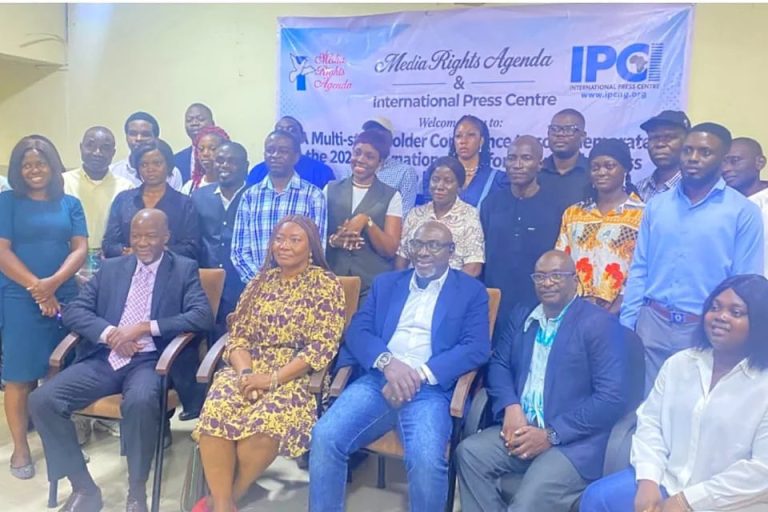
Citing an account by the Executive Director of Media Rights Agenda (MRA), Mr. Edetaen Ojo, of the struggle for the enactment of the Act, the report said: “The FOI had a torturous journey which spanned over 18 years. The fight for the passage of the bill dates as far as 1993, with agitations in the form of workshops and sensitizations from civil societies such as the Media Rights Agenda, Civil Liberties Organisation and the Nigeria Union of Journalists. Eventually, it was celebrated on 28th May, 2011, when President Goodluck Jonathan signed it into law.”
The findings from the data collected were presented in various charts, tables, and other forms of illustrations.
In terms of awareness of the existence of the Act, 56.9 percent of the respondents said they had a high level of awareness of the Law, while 24.1 percent said they were largely aware of the law, with 8.1 percent saying they have low knowledge about the law. Another 8.1 percent said they have very low knowledge of the existence of the law, with the remaining 2.7 percent failing to indicate their level of knowledge about the existence of the Law.
The report said about 81 percent of the respondents affirmed their knowledge of the content of the Act, while 16 percent were not familiar with its content, and 3 percent failing to indicate their level of familiarity with the content. Most of the respondents, numbering 299, indicated that the FOI Act has enhanced their access to information, while 60 others said it had not.
On the constraints that they face in the application of the FOI Act in their journalism practice, 16.2 percent of the respondents said the major challenge facing journalists in the use of the Act is the deliberate hoarding of information by news sources, while 12.2 percent said the lack of adequate awareness and enforcement posed the greatest challenge to the effective utilization of the FOI Act by journalists.
In addition, 33.3 percent of the respondents, constituting the highest number in any of the categories, said the greatest challenge journalists have in using the FOI Act is the problem of the Privacy Law and the Official Secrets Act. However, 16 percent were of the view that there is no cooperation at the government level, especially among the civil servants, when it comes to giving out information to journalists. Another 18.2 percent said media practitioners in Ebonyi and Enugu States were constrained by all the factors outlined, while 4 percent of the respondents did not make their stance known.
The report said only an average number of journalists applied the FOI Act in their practice, suggesting that the high knowledge level of the FOI Act by journalists did not guarantee high usage of it by them.
The research showed that the majority of the journalists responded that the FOI Act is a useful document to guide journalism practice, but its usage at the time of the study was at an average rate.
The report said the data collected and analysed showed that some constraints exist against journalists’ access and usage of the Act, among which is the fact that a majority of the respondents said that the government and its agencies hid vital public information in the name of official secret act of the government. Also, the acts of threat and denial were used, affecting the functionality of the Act.
In their recommendations, the authors called on journalists to spear-head awareness campaigns for the FOI Act, especially to other practising journalists, through the Nigeria Union of Journalists, as well as to citizens in general through various mass media outlets.
The study recommended that governments at the Federal, State, and Local Government levels should encourage and support journalists on the application of the Act to make a positive impact on their journalistic practice.
The authors urged journalists to take advantage of legal and constitutional frameworks in enforcing the Act and using it for their journalistic practice.