“If we lose media freedom, we lose the integrity of the information environments on which all other fundamental rights and freedoms depend,” according to the Organisation for Security and Cooperation in Europe (OSCE) Representative on Freedom of the Media, Ambassador Jan Braathu.
Delivering his opening remarks at a high-level event held at the OSCE Ministerial Council meeting in Vienna, Austria, on December 4, 2025, under the theme “No Security Without Media Freedom,” Ambassador Braathu stressed that, “Media freedom is the frontline of democracy and security in the 21st century, and we must all remain committed and strive even more to see that media freedom commitments are implemented.”
Co-hosted by the co-Chairs of Media Freedom Coalition (MFC), Germany and Finland, in collaboration with the OSCE, the event highlighted that strengthening media freedom is both a human rights obligation and a strategic requirement for comprehensive security.
The session was opened by Ambassador Elina Valtonen, Minister for Foreign Affairs of Finland, who is also MFC co-Chair and OSCE Chairperson-in-Office. She spoke about Finland’s media freedom priorities, saying, “There is no security without media freedom and safety of journalists.”
According to her, “Fifty years ago, the Helsinki Final Act redefined the meaning of security; not merely as the absence of conflict, but as the presence of human rights and fundamental freedoms… It means that media freedom is an integral element of democracy, human rights, global security, and prosperity.”
Ambassador Elina Valtonen said to journalists everywhere, “Whether working under pressure, in exile, or imprisoned: we stand with you and we support you.”
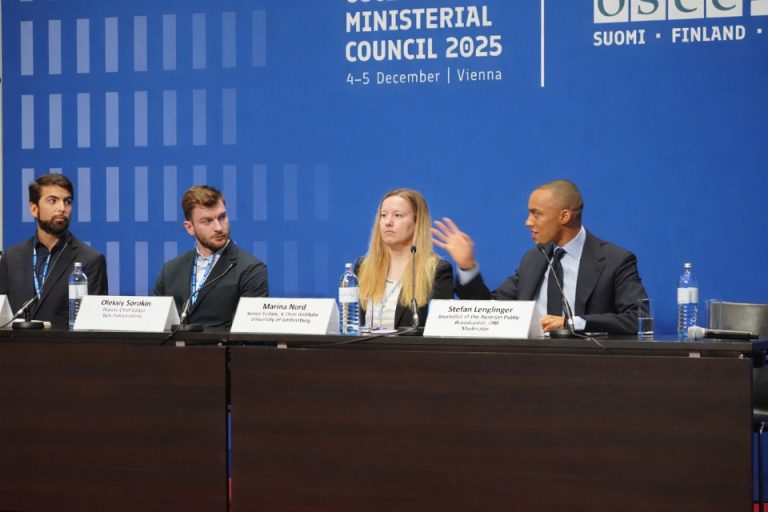
The panel discussion was then kicked off by the Moderator, Stefan Lenglinger, a journalist from the Austrian public broadcaster, ORF.
During the panel discussion, Oleksiy Sorokin, the Deputy Chief Editor of the Kyiv Independent, described the reality of covering the Russian war against Ukraine and highlighted the cases of Russian forces deliberately attacking vehicles clearly marked as “PRESS” in Ukraine.
“This is a direct attack on journalists, for the sake of journalists not reporting,” he said.
Marina Nord, a Postdoctoral Researcher from the V-Dem institute at the University of Gothenburg, contributed to the discussion by sharing some statistics in which she highlighted that: over 72 per cent of the global population now live under autocratic regimes, approximately 5.6 billion people live in countries where media freedom is severely restricted, and only about 300 million people live in countries with robust media freedom.
Ms Nord noted that “Half of all liberal democracies now register rising political polarisation.”
Meanwhile, Scott Griffin, the Executive Director of the International Press Institute (IPI), highlighted the need to fund independent media and underlined that cuts to international media support have serious grave consequences for independent outlets operating in fragile or authoritarian contexts.
He said: “If we believe that independent media is a crucial pillar of security… [cuts to media support] are going to have a negative impact on not only the stability of the countries in question, the freedom of the individuals that live there, but also a negative impact on global security,” adding that: “We are losing insight into processes that we would have had before through independent media.”
In her closing remarks, Germany’s Permanent Representative to the OSCE, Ambassador Susanne Schütz, stressed that “Media freedom is not a peripheral concern, it is a prerequisite for collective security in an age of contested information.”