
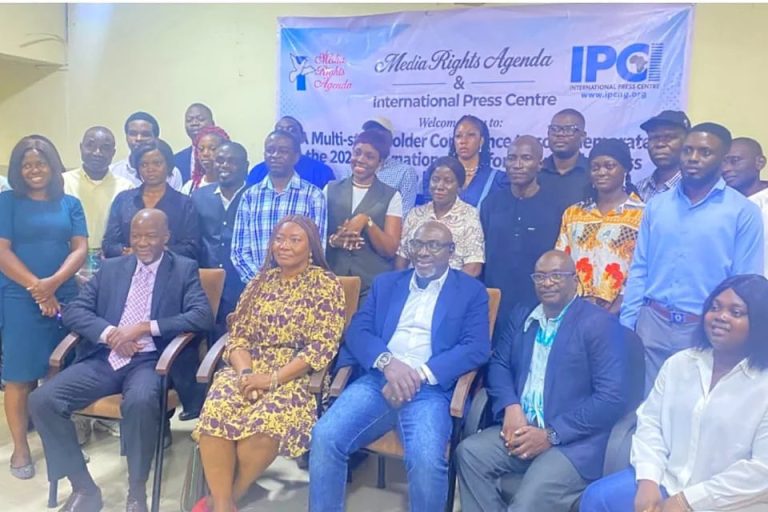
Stakeholders at a conference organised by Media Rights Agenda (MRA) and the International Press Centre (IPC) to commemorate the 2026 International Day for Universal Access to Information (IDUAI) have called for stronger enforcement of Nigeria’s Freedom of Information (FOI) Act, 2011, better record-keeping, improved proactive disclosure of information, and greater use of the law by the media and civil society organisations to enable the Law to realise its purpose.
The stakeholders also urged public institutions to establish dedicated FOI desks staffed by trained personnel, while calling on the judiciary to expedite the hearing and determination of FOI cases to ensure that information obtained through litigation remains timely and relevant.
The recommendations were contained in a communiqué issued at the end of the one-day multi-stakeholder conference held in Lagos on September 28, 2026, with the theme, “Freedom of Information in the Age of Disinformation: Why Transparency Matters More Than Ever.”
The conference brought together journalists and other media professionals, representatives of civil society organisations (CSOs), lawyers, and other stakeholders from different sectors to examine the implementation of the FOI Act and discuss the importance of access to information in promoting transparency and accountability in an information environment increasingly affected by misinformation and disinformation.
The participants recognised that timely access to credible public information has become increasingly important as the volume and speed of information circulating through digital platforms continue to increase.
The stakeholders called on governments at all levels to demonstrate stronger commitment to the effective implementation of the FOI Act and ensure that public institutions comply with their obligations under the law.
They specifically urged public institutions to establish dedicated FOI desks staffed by trained personnel and to proactively publish a wide range of information in accordance with Sections 2(3) and 2(4) of the Act.
They also called on public institutions to improve their record-keeping and information management systems to ensure that requested information can be readily identified and accessed promptly.
The stakeholders further urged public institutions to provide information in formats that are accessible and usable by different categories of information seekers, including women and other groups that may face barriers to accessing public information.
The recommendations came against the backdrop of concerns raised at the conference over poor compliance by hundreds of public institutions at all levels of government with the FOI Act, more than 15 years after its enactment. Participants noted that many public institutions are still failing to respond to requests, or often deny requests without legitimate reasons, delay responses, and fail to proactively publish information as required by law.
They also identified inadequate knowledge of the FOI Act among public officials and members of the public, a culture of secrecy in many public institutions, and a lack of effective sanctions for non-compliance as factors undermining the effectiveness of the law.
The stakeholders therefore called for greater use of the FOI Act by the media, urging news organisations to make more systematic use of the law as a tool for investigative and public-interest journalism and to strengthen journalists’ capacity to formulate, submit, and follow up on FOI requests.
The media was also encouraged to use official information obtained through the FOI process to strengthen the credibility of reporting and help address misinformation and disinformation.
Speaking during the conference, senior broadcaster and investigative journalist Ms Anike Funke-Treasure described the FOI Act as an important investigative tool for Nigerian newsrooms.
“For Nigerian newsrooms, the Freedom of Information (FOI) Act, 2011, is not an academic document; it is our primary investigative shield,” she said. “When reporters routinely pull raw procurement records, budget allocations, and public registries under the FOI Act, we replace viral speculation with unassailable official data.”
She urged newsrooms to integrate FOI requests into daily newsgathering rather than treating them as tools reserved only for long investigations.
The stakeholders also called on civil society organisations to intensify public enlightenment, monitoring, and advocacy around implementation of the FOI Act and support citizens in exercising their right of access to information.
They urged media and civil society organisations to facilitate or strengthen collaboration in monitoring compliance with the Act and documenting cases of wrongful denial, delay and other barriers to access.
Presenting a paper on behalf of the Women Advocates Research and Documentation Centre (WARDC), Mr Olaniyi Olaniyan, on behalf of Dr Abiola Akiyode-Afolabi, similarly called for civil society organisations to make more strategic use of the law.
“The Freedom of Information Act gave Nigerians a legal right. Civil society must help turn that legal right into a lived reality. Information is power. Access to information is accountability. And accountability must include women and girls,” he said.
He stressed the need for CSOs to file strategic requests, track responses, monitor compliance, and convert information into evidence for advocacy, particularly on issues affecting women and girls.
The stakeholders also called for stronger legal enforcement of the FOI Act. They urged the Attorney-General of the Federation to exercise his oversight responsibilities with greater rigour and issue appropriate directives against officials and institutions that persistently and willfully violate the provisions of the law, including by wrongfully denying information requests.
They called on the judiciary to give expedited hearings and judgments in FOI cases, noting that delays in litigation could undermine the timeliness and continued relevance of information that may ultimately be disclosed.
Legal practitioner Alimi Adamu highlighted the central role of lawyers in making the FOI Act work, noting that Nigeria’s purely judicial enforcement model makes professional legal support indispensable.
“Without the active involvement and engagement of lawyers, the effective implementation of the FOI Act will not be possible. Lawyers must therefore use all the resources at their disposal, their training, profession, skills, status in society, to ensure that the Law is obeyed and respected,” he stated.
He called on legal practitioners to provide more pro bono support, strategic public-interest litigation, and advice to public institutions on compliance.
The conference also recommended greater attention to the gender dimensions of FOI implementation. Participants called on relevant authorities and stakeholders to adopt gender-responsive approaches that address barriers faced by women and other marginalised groups and ensure inclusive access to information.
MRA Programme Officer, Ms Ayomide Eweje, who presented a paper on the gender dimension of FOI implementation, noted that equal rights under the law did not automatically produce equal access in practice.
“Gender-responsive FOI implementation is not about giving women more rights than men. It is about identifying and addressing factors that may prevent people from exercising an existing right equally,” she said.
She called for deliberate efforts to remove barriers that limit women’s ability to exercise the right of access to information.
The stakeholders further called on the National Orientation Agency (NOA) to intensify public enlightenment on the right of access to information and the provisions of the FOI Act, particularly at the grassroots level.
They urged all stakeholders to increase public awareness of the right to information and provide practical information to citizens and communities on how to make effective requests under the Act.
The conference also recommended that stakeholders document and share experiences of using the FOI Act, including challenges encountered in requesting and obtaining information, to strengthen collective knowledge and advocacy for effective implementation.
In response to the growing challenge of misinformation and disinformation, participants called on all stakeholders, particularly public institutions, the media and civil society organisations, to prioritise transparency and the proactive disclosure of accurate information as critical measures for upholding information integrity.
They also urged public institutions and other relevant stakeholders to leverage digital technologies to improve the publication, accessibility, storage and dissemination of information, while ensuring that the use of such technologies did not create additional barriers to access.
The stakeholders called for stronger cooperation and information-sharing among relevant actors to promote an information environment in which citizens can access reliable information, participate meaningfully in public affairs and hold public officials and institutions accountable.
Participants reaffirmed that the right of access to information remains central to transparency, accountability, as well as public participation in democratic governance, and committed to working collaboratively to advance effective implementation of the FOI Act and uphold the public’s right to know.
They commended Media Rights Agenda and the International Press Centre for their continuing efforts to promote access to information, media freedom, transparency and accountability in Nigeria.