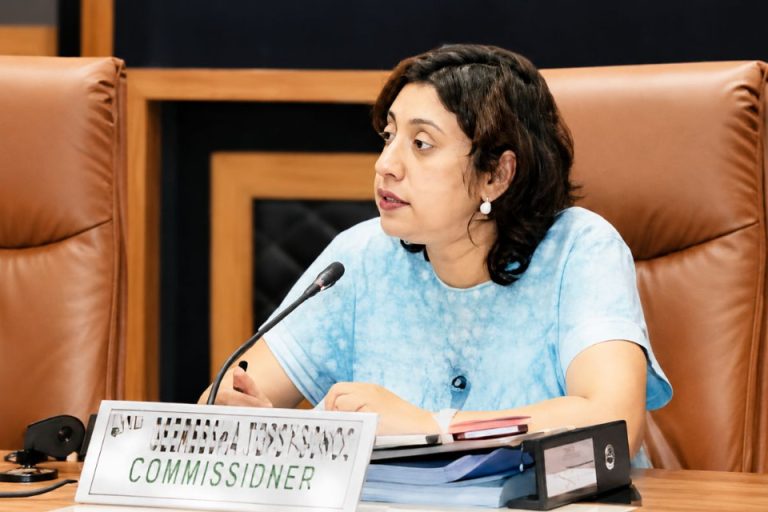
The Special Rapporteur on Freedom of Expression and Access to Information in Africa of the African Commission on Human and Peoples’ Rights (ACHPR), Commissioner Ourveena Geereesha Topsy-Sonoo, has again called on Governments in Africa to refrain from restricting access to the internet and social media platforms at all times, particularly before, during and after elections, in order to ensure the free flow of information and freedom of expression.
In her Intersession Report presented at the 87th Ordinary Session of the Commission, held from April 24 to May 20, 2026 in Banjul, The Gambia, pursuant to Rules 25(3) and 64 of its Rules of Procedure (2020), the Special Rapporteur urged State Parties to respond to letters of appeal from her and other special mechanisms of the Commission by providing clarifications on reported violations of freedom of expression and access to information, particularly the arrest and detention of journalists and human rights defenders, among others.
The report covered activities undertaken by the Special Rapporteur during the intersession period between November 2025 and May 2026.
She called on all stakeholders to contribute to the development of the African Guidelines on Promoting and Harnessing Data Access as a Tool for Advancing Human Rights and Sustainable Development in the Digital Age, to assist States to monitor technology companies in respect of their duty to maintain information integrity through independent fact-checking in accordance with the Commission’s Resolution 630, which was adopted by the Commission in 2025.
The Special Rapporteur said in view of the fact that access to information and access to data reinforce each other and given that access to information promotes transparency while access to data enables deeper analysis, participation, and evidence-based decision-making, the Commission adopted Resolution 620 on Promoting and Harnessing Data Access as a Tool for Advancing Human Rights and Sustainable Development in the Digital Age, during its 81st Ordinary Session, which was held in Banjul from October 17 to November 6, 2024.
According to her, the Resolution mandated the Commission’s mechanism on freedom of expression and access to information in Africa, to develop appropriate normative standards to guide data collection and deployment and address access issues concerning data.
She said it was in this regard that she worked with various stakeholders to develop the African Guidelines on Promoting and Harnessing Data Access as a Tool for Advancing Human Rights and Sustainable Development in the Digital Age.
The Special Rapporteur explained that overall, the Guidelines provide a human rights-based framework for balancing privacy, access and innovation, while fostering accountability, equity, and sustainable digital transformation across Africa, building on the Commission’s soft law documents on Article 9 of the African Charter.
She identified the key principles of the draft Guidelines as including, among other things, maximum disclosure of public and relevant private data, data justice and equity for marginalized communities, and the importance of data for public accountability, while prioritizing systems for data collection, storage and dissemination built with proactive disclosure features, accessibility standards and interoperability by default, and security provisions.
In addition, the Special Rapporteur said, the Guidelines stress the importance of access to platform-held data for public interest research and the need for inclusive, affordable, multilingual access strategies, among others.
She explained that the draft Guidelines, which can be accessed on the Commission’s website in English, French and Portuguese, also call on States to establish robust national frameworks for data governance, domesticate the African Union Convention on Cyber Security and Personal Data Protection and the African Union Data Policy Framework, in addition to implementing open data policies as part of measures to ensure their effectiveness.
The Special Rapporteur reported that in order to ensure a participatory process in the development of the draft Guidelines, a Call for Contributions was issued on the Commission’s website, on April 15, 2026, which invited stakeholders, including State actors, non-State actors, National Human Rights Institutions, civil society organizations, in addition to the Commission’s partners, to forward their inputs on the draft Guidelines to the Commission by close of business on July 14, 2026.
She reiterated the call on all interested stakeholders to work with the Commission to develop the Guidelines by submitting feedback, comments and proposed amendments to the draft document, in order to enrich it and ensure that the normative document which will eventually be adopted by the Commission, takes into account all relevant views in the final document.
The Special Rapporteur also called on all stakeholders to contribute to the development of Guidelines on the assessment of public interest content in this digital era for all platforms operating in Africa in accordance with Resolution 631, which was also adopted by the Commission in 2025.
She urged States Parties to sign, ratify and domesticate the AU Convention on Cyber Security and Personal Data Protection and refrain from restricting access to the internet and social media platforms at all times, but particularly before, during and after elections, in order to ensure the free flow of information and freedom of expression.
On the Commission’s Resolution 654 on the Promotion and Protection of Artistic Freedom in Africa, she explained that the ACHPR adopted the soft law instrument because of its concern regarding reports of censorship, intimidation, arbitrary arrests, and other forms of repression targeting artists, cultural professionals, creative content creators and disseminators of artistic creativity on the continent.
The Special Rapporteur, therefore, called on States to, among other things, respect, protect and promote the right to artistic freedom of expression and ensure that creators and disseminators of artistic creativity are protected from arbitrary actions in response to the legitimate exercise of their right to freedom of expression.
She also noted that Resolution 657 on Access to Information and the Right to a Healthy Environment was adopted in view of the importance of accurate and reliable information, in addition to transparency, participation and accountability as necessary tools to address environmental harm and promote resilience.
The Special Rapporteur therefore called on States to ensure timely, accurate, accessible and proactive disclosure of climate and environmental information, and guarantee meaningful public participation and access to justice in environmental decision-making, as integral components of environmental protection and sustainable development.
She said in view of the increasing submission of State Periodic Reports, National Human Rights Institutions (NHRIs) and non-governmental organizations (NGOs) should consistently submit timely shadow reports in accordance with Rule 79 of the Commission’s Rules of Procedure (2020) and highlight in them the situation relating to the rights of freedom of expression and access to information in the various countries in order to ensure that the Commission and the special mechanisms are informed of the current human rights situation.
The Special Rapporteur stressed that such consistent and timely submission of shadow reports by NHRI and NGOs will undoubtedly contribute to a productive engagement on the relevant State Reports by the Commission.