
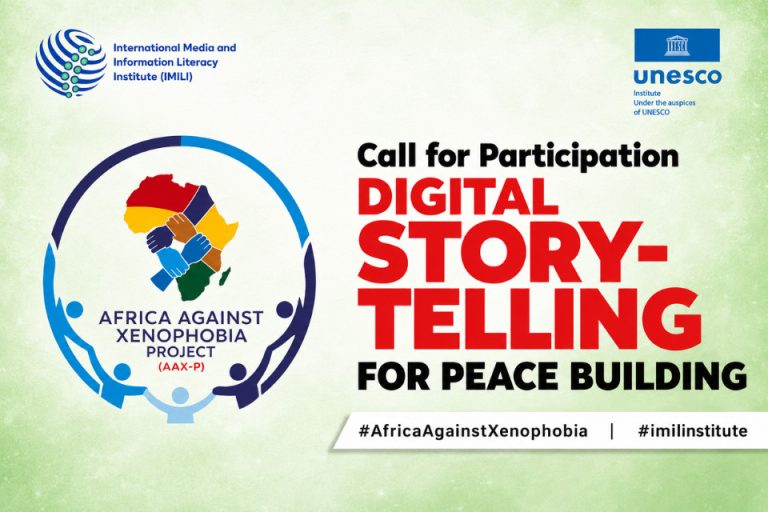
The Abuja, Nigeria, based International Media and Information Literacy Institute (IMILI), a UNESCO Category 2 Institute on Media and Information Literacy (MIL), has opened applications for its Digital Storytelling for Peacebuilding activity under the Africa Against Xenophobia Project (AfAX-P).
The initiative invites young Africans to create original digital stories that promote unity, tolerance, and peace while countering xenophobia, misinformation, disinformation, and hate across the continent.
According to IMILI, the Africa Against Xenophobia Project (AfAX-P) is a strategic initiative aimed at combating xenophobia and hate fueled by misinformation and disinformation, which threaten Africa’s social cohesion, regional unity, and economic integration. The initiative encourages young Africans to harness the power of digital media by producing original stories that promote unity, tolerance, peaceful coexistence, and the rejection of xenophobia and misinformation. Through responsible digital storytelling, participants are expected to highlight Africa’s diversity and inspire collective action toward a more peaceful and inclusive continent.
The call is open to individuals between 15 and 30 years who are of African nationality or heritage and reside either within Africa or in the diaspora. Entries must be original works created by the applicant or team and must not have been previously published or received awards.
Submissions may be made in English, French, Arabic, Portuguese, or any African language, provided that non-English entries include English subtitles.
Participants may submit entries in one of four categories, including Video, including short films, documentaries, animations, cartoons, or vlogs of up to 3 minutes in MP4 format with a minimum resolution of 720p; Podcast/Audio Drama, consisting of original audio narratives, interviews, or soundscapes of up to 3 minutes in MP3 or WAV format; Interactive Media, such as web-based stories, digital comics, interactive presentations, or games submitted through a functional web link with access instructions; and Photography, comprising high-resolution JPEG or PNG images accompanied by a title and a 100- to 200-word description explaining the context and message of the photograph. Minor digital enhancements are permitted for photographs, while AI-generated images must be clearly declared at the time of submission.
To participate, applicants are required to prepare an original entry in one of the four categories addressing the theme of combating misinformation- and disinformation-driven xenophobia while promoting peace. Entries should be submitted through the Digital Storytelling for Peacebuilding online application form, after which participants are encouraged to share their submissions on their preferred social media platforms using the official hashtags #ImiliInstitute and #AfricaAgainstXenophobia, #UNESCO, and #Africa.
Submissions will be evaluated based on their relevance to the theme of promoting unity, tolerance, and peace (20%), creativity and originality (25%), the impact and clarity of the message (25%), technical quality (15%), and the level of social media engagement (15%), including the extent to which the entry generates meaningful discussion and audience interaction through likes, shares, and comments on social media platforms.
The organisers stated that the top 50 finalists will have their works featured across Africa Against Xenophobia Project activities. The top 20 winners will receive cash prizes, mentorship opportunities with leading media professionals, and invitations to an exclusive virtual workshop where they will present the stories behind their submissions. Selected entries will also be showcased on the IMILI website and may be incorporated into the institute’s educational resources. In addition, finalists will receive support to use their stories in engaging communities as part of the Africa Against Xenophobia campaign, while all participants will receive certificates of participation.
Submissions will be accepted from August 1 to September 15, 2026. The first 50 finalists will be announced on November 30, 2026, while the top 20 winners will be announced on December 15, 2026.
For further information, interested participants can visit www.imilinstitute.org or send inquiries via email to info@imilinstitute.org.
Visit https://www.imilinstitute.org/afax-p/digital-storytelling-for-peace-building to read about the entries.