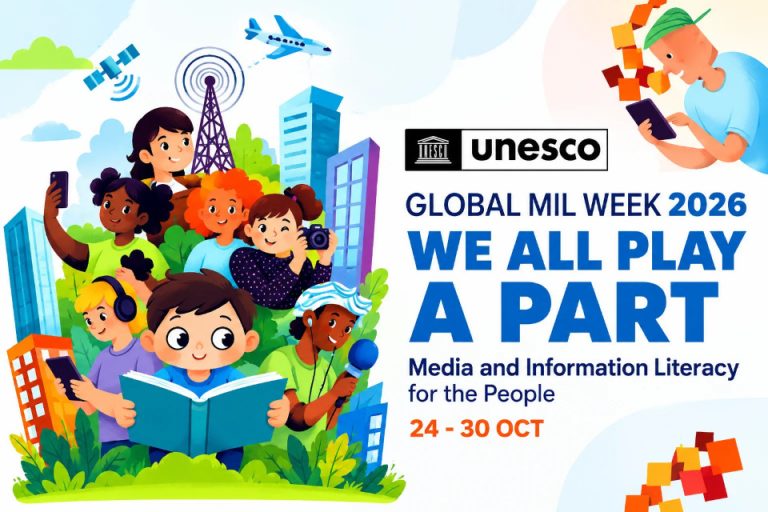
The United Nations Educational, Scientific, and Cultural Organization (UNESCO) will commemorate this year’s Global Media and Information Literacy (MIL) Week from October 24 to 31, 2026, with a global campaign emphasising the shared responsibility of individuals and institutions in building a more informed and resilient information environment.
The theme for this year’s observance is “We All Play a Part – Media and Information Literacy for the People”, reflecting UNESCO’s call for governments, educators, journalists, researchers, young people, digital content creators, regulators, parents, and civil society organisations (CSOs) to contribute to improving people’s ability to navigate today’s complex information environment.
UNESCO said the 2026 edition would adopt a decentralised and participatory approach, bringing together regional and thematic activities organised by UNESCO offices and partners around the world.
According to the organisation, the interconnected activities will address some of the most pressing information challenges facing societies while promoting practical initiatives, cross-sector partnerships, and the exchange of knowledge across regions.
It explained that the theme recognises that MIL cannot be advanced by schools or media organisations alone, but requires contributions from different sectors of society.
The organisation’s global campaign, #WeAllPlayAPart, seeks to reinforce this message by encouraging people and institutions to take an active role in strengthening the information ecosystem.
UNESCO’s broader work on MIL focuses on developing the knowledge, skills, attitudes, and values needed for people to search for, access, critically evaluate, use, and contribute to information and media content.
It identified MIL as increasingly important in responding to challenges including misinformation and disinformation, hate speech, declining trust in media, and the transformative effects of digital technologies, particularly artificial intelligence (AI).
Nigeria will feature prominently in the 2026 global observance, with Abuja scheduled to host “Africa Plays a Part” from October 28 to 29, 2026.
The Abuja event is one of a series of flagship regional and thematic activities planned in different parts of the world, with other events taking place in Cairo, Egypt; Nairobi, Kenya; Montreal, Canada; Chișinău, Moldova; New Delhi, India; Bishkek, Kyrgyzstan; Jakarta, Indonesia; Dubrovnik, Croatia; and Al Rayyan, the third-largest municipality in Qatar; among other locations.
The 2026 programme will also include a Youth Hackathon, titled “Play Your Part: Youth Designing the Future of Media and Information Literacy,” an initiative that reflects UNESCO’s recognition of young people not only as consumers of information but also as active creators and distributors of digital content.
The organisation has also launched a global campaign encouraging stakeholders to participate in the #WeAllPlayAPart movement.
The programme will examine MIL from a range of perspectives, with scheduled flagship activities, including “Digital Content Creators and MIL”, taking place in Nairobi from October 26 to 27; “MIL and Formal Education”, to be held in New Delhi on October 26 and 27; “Policymakers and MIL” in Bishkek on October 28 and 29; and “Regulators and MIL”, scheduled to be held in Latin America on October 29.
An event focusing on parents, caregivers, and MIL is also planned in Jakarta, while the MIL Cities initiative will hold activities in Dubrovnik and Al Rayyan, from October 28 to November 3.
Beyond the flagship events, UNESCO is inviting MIL stakeholders around the world to organise their own activities as part of the global observance.
According to UNESCO, activities may be organised online or in person and can include workshops, conferences, debates, exhibitions, training sessions, youth activities, campaigns, and other MIL initiatives.
Activities can take place during September, October, or November 2026, and organisers are encouraged to register their events through UNESCO’s Global MIL Week platform.
The 2026 observance comes against a backdrop of rapid changes in the global information environment, including the growing use of AI, social media platforms, and digital content creation.
UNESCO reports that 56 percent of Internet users frequently use social media to stay informed about current events, while 85 percent of citizens are worried about the impact of online disinformation.
It also noted that nearly two-thirds of digital content creators do not systematically fact-check information before sharing it online, arguing that MIL can help people engage more critically with information, navigate online environments safely and contribute to greater trust in information ecosystems and digital technologies.
UNESCO said MIL can strengthen citizens’ capacity to participate in dialogue, exercise freedom of expression and access to information, promote gender equality and diversity, and contribute to peace and sustainable development.
The 2026 Global MIL Week therefore seeks to move the discussion beyond treating MIL as an educational issue alone and hopes to demonstrate how collective action can strengthen people’s ability to understand, assess, and use information responsibly by bringing together policymakers, journalists, educators, researchers, technology and digital-content communities, young people, parents, regulators, and civil society.
UNESCO said the 2026 Global MIL Week will ultimately seek to strengthen international cooperation and demonstrate how contributions from different sectors can advance MIL for everyone.