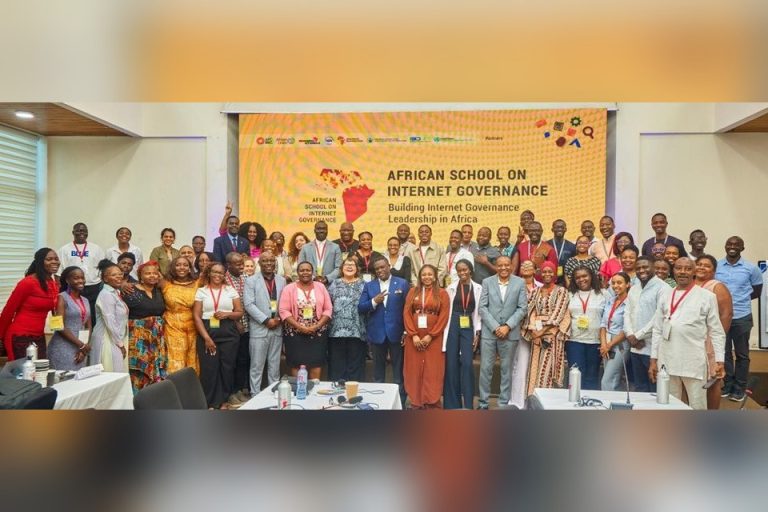

As part of its 15th anniversary programme under the Swiss Chairship, the Freedom Online Coalition (FOC) convened a regional dialogue at the Africa Internet Governance Forum (Africa IGF) in Accra, Ghana.
Bringing together representatives from civil society, governments, research institutions and the FOC Advisory Network, the discussion explored how digital rights and internet governance in Africa have evolved since 2011, and how the Coalition can contribute to shaping the region’s digital future.
The moderator was Isabelle Lois, Senior Policy Advisor, Federal Office of Communications of Switzerland, representing the 2026 FOC Chairship, while the panellists were: Dr Jamal Seidu Tonzua, Cybersecurity Authority Ghana; Mohamed Farahat, Policy and Legal Expert, FOC Advisory Network Member; Liz Orembo, Research ICT Africa, FOC Advisory Network Co-Chair; and Edetaen Ojo, Media Rights Agenda, FOC Advisory Network Member.
Opening the dialogue, Isabelle Lois, representing the 2026 FOC Chairship, briefly introduced the Coalition’s work and marked its 15th anniversary as an opportunity to reflect on progress, lessons learned and future priorities. She also highlighted the role of the FOC Advisory Network in bringing independent expertise and regional perspectives into policy discussions.
Over the past 15 years, expanded connectivity has transformed Africa’s digital landscape, opening up new opportunities for communication, participation and development. Yet greater connectivity has not necessarily translated into stronger digital rights. Speakers pointed to the continued prevalence of surveillance, restrictions on online freedoms and growing cybersecurity threats, highlighting the tension between technological development, national security and the protection of fundamental rights.
These tensions are becoming more pronounced with the emergence of AI and other new technologies. Participants noted that questions of digital sovereignty and security can no longer be considered in isolation from human rights, particularly as geopolitical competition and malicious cyber activities create additional pressures on governments and institutions.
A particular concern was the gap between legislation and its practical enforcement. While data protection laws have been introduced in many African countries, implementation remains uneven, and the independence and capacity of regulatory authorities are not always assured. Participants also discussed the risks associated with digital identity systems, especially where safeguards against surveillance and misuse are insufficient. Proposals to restrict children’s access to social media raised a related challenge: how to address legitimate online safety concerns without compromising rights and freedoms.
The IGF’s bottom-up approach was recognised as an important achievement in bringing different perspectives into internet governance discussions. National and regional IGF initiatives offer valuable spaces for stakeholders to share experiences, shape priorities and contribute to wider policy debates.
Nevertheless, participants questioned whether the growing number of regional and international governance initiatives is delivering sufficient results. Overlapping processes can create duplication, stretch already limited resources and make it harder to coordinate positions and follow up on recommendations. The challenge is therefore not simply to create more opportunities for dialogue, but to ensure that existing processes lead to meaningful outcomes.
The discussion also highlighted persistent inequalities in participation. Civil society organisations and communities directly affected by digital policies often face financial, institutional and practical barriers to engaging in international processes. Ensuring that these voices are not only present but able to influence decisions remains essential to legitimate and effective multistakeholder governance.
Participants further stressed that meaningful engagement depends on an enabling environment. Access to information, the right to information and freedom of expression, supported by appropriate legal and institutional frameworks, are fundamental to public accountability and inclusive digital policymaking.
Looking ahead, speakers identified institutional capacity as a key condition for turning commitments into practice. Strengthening the independence and effectiveness of data protection authorities, developing legal expertise and equipping lawyers and other stakeholders to respond to emerging digital rights challenges were highlighted as important priorities.
Participants also called for more accessible and inclusive governance processes, allowing communities most affected by technological developments to contribute to decisions that shape their rights. At the regional and international levels, closer coordination between existing initiatives could help reduce duplication, maximise available resources and improve the implementation of recommendations.
On emerging technologies, the discussion pointed to the need for safeguards that are grounded in human rights. This includes ensuring that digital identity systems are designed and used responsibly, and that measures addressing children’s online safety are proportionate, evidence-based and respectful of fundamental freedoms.
The dialogue highlighted the potential for the FOC to act as a stronger bridge between African expertise, regional priorities and international policymaking. Its combination of government membership and the expertise of the Advisory Network provides an opportunity to bring human rights perspectives more directly into policy discussions and support their translation into practice.
Participants identified several areas where the Coalition could make a meaningful contribution, which will help inform the FOC’s future priorities:
- Deepen engagement with African governments, civil society, researchers and affected communities to ensure regional experiences and priorities are reflected in global digital governance discussions.
- Help translate human rights commitments into practice by supporting effective data protection frameworks, independent regulatory authorities and accountability mechanisms.
- Promote human rights-centred approaches to AI, digital identity and cybersecurity, ensuring that security and innovation do not undermine fundamental freedoms.
- Strengthen inclusive multistakeholder processes and address the barriers preventing affected communities from participating in digital policymaking.
- Encourage greater coordination between regional and global governance initiatives with a stronger focus on implementation and follow-up.
- Mobilise the expertise of the FOC Advisory Network to support governments through knowledge-sharing, capacity-building and policy advice.