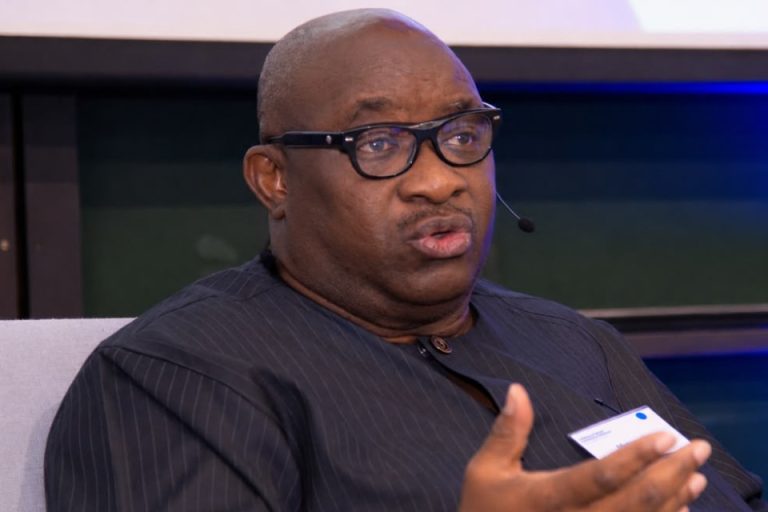
The Executive Director of Media Rights Agenda (MRA), Mr. Edetaen Ojo, has called for a fundamental redesign of digital governance initiatives in Africa to ensure that they are more inclusive, as key communities, including independent journalists, women, young people, rural communities, and persons with disabilities, remain underrepresented in digital policy processes.
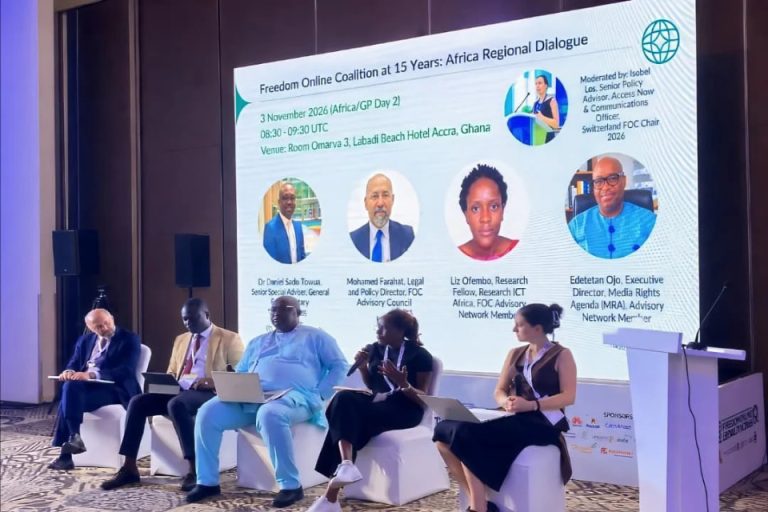
Speaking on November 3, 2026, at the Africa Regional Dialogue convened during the Africa Internet Governance Forum (Africa IGF) held at the Labadi Beach Hotel in Accra, Ghana, Mr. Ojo observed that the people most affected by decisions concerning the digital environment are often the least represented in the processes through which those decisions are made.
The Dialogue was organized by the Freedom Online Coalition (FOC), an alliance of 42 countries from around the world working together to advance Internet freedom, as part of a series of regional dialogues being convened throughout the year in the run-up to the Coalition’s 15th anniversary, which will be celebrated in December 2026 under the Chairship of Switzerland.
Moderated by Ms Isabelle Lois, a Senior Policy Advisor at the Federal Office of Communications (OFCOM) of Switzerland, the Dialogue had as speakers Dr Jamal Seidu Tonzua, Deputy Director-General for Regulatory Operations at the Cybersecurity Authority, Ghana; Ms Liz Orembo, a Research Fellow at Research ICT Africa, and Co-chair of the FOC Advisory Network; Mr. Mohamed Farahat, a legal and policy expert and member of the FOC Advisory Network; and Mr. Ojo, who is also a member of the FOC Advisory Network.
Mr. Ojo noted that independent journalists and media organisations, particularly smaller outlets, community media, and local-language media, are among the important stakeholders whose perspectives are missing from digital governance conversations, adding that such journalists and media organisations depend heavily on digital technologies to perform their democratic functions but are directly affected by decisions and developments relating to platform content moderation, algorithmic distribution of news, artificial intelligence, and the use of journalistic content to train AI models.
He identified other issues affecting them to include disinformation and coordinated online manipulation, Internet shutdowns and network disruptions, digital surveillance, threats to confidential sources, the concentration of digital advertising revenues, and the challenge of economic sustainability of independent journalism.
Despite being directly affected by these developments, Ojo noted that independent journalists and media organisations often have little or no participation in developing the rules governing the digital environment.
He also identified women and girls, particularly those experiencing intersecting forms of discrimination, as groups whose voices are insufficiently represented in digital policy development.
Young people, he said, are another important but underrepresented constituency, despite being among the most active users of digital technologies and likely to live longest with the consequences of decisions being taken today.
Mr. Ojo further highlighted the exclusion of rural communities and people living in underserved areas, observing that digital governance discussions frequently take place in major cities, international conferences, and well-connected institutional environments that are often inaccessible to such populations.
He added that persons with disabilities also have significant interests in digital governance, particularly in relation to digital accessibility, assistive technologies, digital identity, artificial intelligence applications, and online public services, but are not adequately represented in relevant conversations.
Linguistically marginalised communities also face exclusion because African languages and languages spoken by smaller communities are largely absent from digital governance discussions, limiting their ability to participate meaningfully.
Identifying the factors responsible for exclusion, Mr. Ojo pointed to unequal access to resources, gaps in knowledge of technical and policy issues, language barriers, and the centralisation of decision-making processes.
He argued that addressing these challenges would require more than simply inviting additional stakeholders to existing meetings and consultations, arguing that there should be a redesign of participation processes to make inclusion an integral part of their structure and ensuring that different communities can engage effectively in decisions affecting their rights and interests.
He also called for more detailed mapping of the stakeholder environment to identify the full range of interests, roles, and participation barriers, allowing organisers and policymakers to develop more targeted approaches to inclusion.
Mr. Ojo questioned some of the assumptions underpinning the prevailing multistakeholder approach to Internet and digital governance, arguing that the broad categorisation of stakeholders often obscures important differences within individual groups.
He cited the treatment of governments as a single stakeholder category as an example, noting that the category brings together the Executive, Judiciary, parliamentarians, security and law enforcement officials, among others, all of whom have different competencies, responsibilities, and interests that influence their positions on digital governance issues.
Mr. Ojo argued that the existing multistakeholder approach does not sufficiently account for these differences.
Similarly, he observed that civil society is often treated as a homogeneous stakeholder group, despite comprising organisations and individuals working at local, national, regional, and international levels across numerous sectors and issues, with different interests and methods of work.
Mr. Ojo also challenged the assumption that stakeholders within the same category possess comparable levels of power, resources, capacity, ability to participate, and influence.
Using governments as an example, he noted that resources, institutional capacities, and ability to engage in digital governance processes vary considerably among governments, making it inappropriate to assume they all participate on an equal footing.
He stressed that a more detailed understanding of the different actors, their interests, institutional roles, and the barriers they face is necessary to design and implement an effective multistakeholder approach.
Mr. Ojo’s intervention underscored the need to move beyond formal stakeholder representation towards more meaningful participation that takes account of inequalities in access, resources, knowledge, institutional influence, and decision-making power.
He maintained that digital governance processes in Africa must create opportunities for the people and communities most affected by digital policies and technologies to influence the decisions that shape their digital rights and future.