
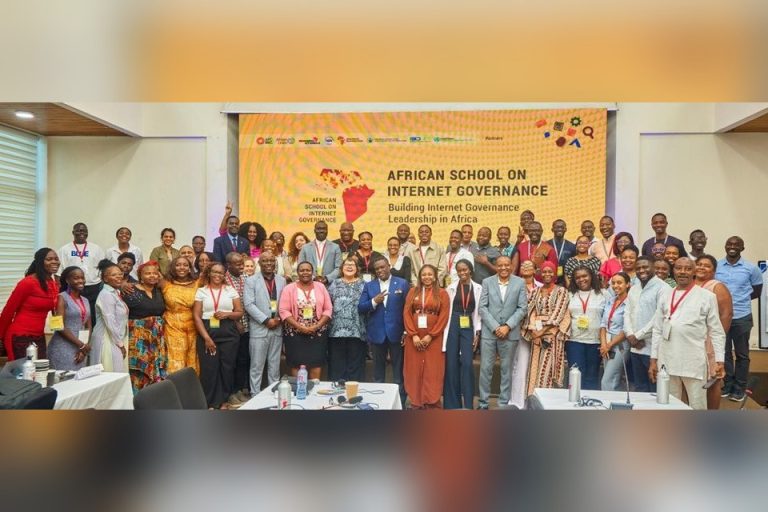
The Executive Director of Media Rights Agenda (MRA), Mr. Edetaen Ojo, has highlighted the importance of African human rights frameworks in protecting digital rights, freedom of expression, and access to information, urging stakeholders from various sectors to pay greater attention to the instruments and mechanisms in their efforts to safeguard fundamental freedoms in the digital environment.
Mr. Ojo made the observations in a presentation titled “Human Rights and Digital Rights: A Regional Perspective”, which he made to fellows from Governments, the Judiciary, civil society, the Media, research and academic institutions, the technical community, multilateral bodies, and philanthropic organizations at the 2026 edition of the African School on Internet Governance (AfriSIG 2026), which took place in Accra, Ghana, from October 27 to November 1, 2026.
His presentation underscored the continuing development of the African human rights system and the importance of regional standards in responding to the challenges posed by technological developments, while ensuring that the protection of fundamental rights remains central to Internet governance and digital policy across the continent.
He examined the evolution of the African human rights system, the development of regional standards on freedom of expression and Internet freedom, and emerging initiatives by the African Commission on Human and Peoples’ Rights (ACHPR) to address challenges arising from the digital environment, and explained that human rights and digital rights in Africa are protected not only by international and national legal frameworks but also by regional instruments and institutions.
Mr. Ojo identified the African Commission on Human and Peoples’ Rights and the African Court on Human and Peoples’ Rights as the system’s two principal institutions, operating within the framework of the African Charter on Human and Peoples’ Rights, which was adopted on June 27, 1981, and entered into force on October 21, 1986, as well as a protocol to the Charter, establishing the Court.
According to him, the Commission, a quasi-judicial body established under the Charter, began operating in 1987 and is based in Banjul, The Gambia, while the African Court was established to complement and reinforce the Commission through a Protocol adopted in June 1998 and entered into force in January 2004.
He recalled that the Court officially began operations in Addis Ababa, Ethiopia, in November 2006, before relocating to Arusha, Tanzania, in August 2007 and began receiving cases in 2008, delivering its first decision in 2009.
Addressing the evolution of freedom of expression and access to information protections in Africa, Mr. Ojo explained that although Article 9 of the African Charter guarantees these rights, the limitations of the provision became increasingly apparent even before the emergence of the digital age.
He identified two major weaknesses: the absence of sufficient normative clarity to address the complexities of freedom of expression, access to information, and media freedom, and the failure of the 1981 instrument to anticipate or provide protection for digital rights and freedom of expression online.
These gaps, he said, informed the development and adoption of the Declaration of Principles on Freedom of Expression in Africa in 2002.
Mr. Ojo noted that the rapid transformation in how people access, share, and consume information, alongside the emergence of new online threats, soon created additional challenges for the existing framework and identified surveillance, data breaches, disinformation, digital exclusion, censorship, and artificial intelligence (AI), among other developments, as issues that have complicated the protection of human rights in the digital environment.
He said these developments necessitated further efforts to develop regional norms and standards, resulting in two important instruments, namely the African Declaration on Internet Rights and Freedoms and the African Commission’s 2019 Declaration of Principles on Freedom of Expression and Access to Information in Africa.
On the African Declaration on Internet Rights and Freedoms, Mr. Ojo explained that it was developed by a coalition of African civil society organisations and first launched at the ninth Internet Governance Forum (IGF) in Istanbul, Turkey, in September 2014 and subsequently updated and relaunched at the 10th IGF in João Pessoa, Brazil, in November 2015, and later endorsed by several intergovernmental and multilateral organisations at regional and international levels.
He noted that although the Declaration is described as African, its principles are universal and consistent with international norms and standards, adding that it, however, places particular emphasis on issues considered especially relevant to the African context, including Internet access and affordability, cultural and linguistic diversity, the right to development, and access to knowledge.
Mr. Ojo also examined the ACHPR’s Declaration of Principles on Freedom of Expression and Access to Information in Africa, which was adopted in November 2019 at the Commission’s 65th Ordinary Session in The Gambia, replacing the earlier 2002 Declaration, and identified Principles 5, 17, and 37 to 42 as particularly relevant to Internet governance, digital rights, and Internet freedom.
According to him, Principle 5 provides that the exercise of the rights to freedom of expression and access to information must be protected from interference both online and offline, while Principle 17 requires public regulatory authorities exercising powers in broadcasting, telecommunications, and Internet infrastructure to be independent and adequately protected against political, commercial, and other forms of interference.
The same principle, he said, also encourages a multi-stakeholder model of regulation to shape the use and evolution of the Internet.
Mr. Ojo explained that Principles 37 to 42 established important obligations for African States, including facilitating the exercise of freedom of expression and access to information online and ensuring that individuals have the necessary means to exercise these rights.
He highlighted the recognition that universal, equitable, affordable, and meaningful Internet access is essential for the realisation of freedom of expression, access to information, and other human rights.
Mr. Ojo said the principles also require States to cooperate with relevant stakeholders in adopting laws, policies, and other measures to promote universal, equitable, affordable, and meaningful Internet access without discrimination.
On Internet disruptions, he noted that the Declaration requires States not to engage in or condone disruptions of access to the Internet and other digital technologies affecting segments of the public or an entire population.
On emerging technologies, he highlighted the requirement by the Declaration that the development, use, and application of AI, algorithms, and similar technologies by Internet intermediaries must comply with international human rights law and standards and must not infringe on freedom of expression, access to information, or other human rights.
Mr. Ojo said the Declaration also places restrictions on communication surveillance, requiring that targeted surveillance be authorised by law, consistent with international human rights standards and based on specific and reasonable suspicion that a serious crime has been or is being committed, or for another legitimate purpose.
In addition, he said, the Declaration requires States to adopt laws protecting individuals’ personal information in accordance with international human rights standards.
Mr. Ojo highlighted three additional soft-law instruments being developed by the Commission to strengthen freedom of expression, particularly online, namely the “African Guidelines on Promoting and Harnessing Data Access as a Tool for Advancing Human Rights and Sustainable Development in the Digital Age”; the “Guidelines on Information Integrity and the Obligations of Technology Companies Operating in Africa”; and the “Guidelines on Public Interest Content in the Digital Era.”
He explained that the Guidelines on Access to Data, developed under the auspices of the Special Rapporteur on Freedom of Expression and Access to Information pursuant to ACHPR Resolution 620 of 2024, were awaiting the Commission’s final approval.
The instrument, he said, is intended to provide guidance for monitoring the impact of digital platforms and AI services on information integrity in Africa, while promoting access to data as a tool for advancing human rights and sustainable development in the digital age.
Mr. Ojo said the draft Guidelines on Information Integrity and the Obligations of Technology Companies Operating in Africa, developed pursuant to Resolution 630 of 2025, are currently at the public consultation stage and open to comments and contributions from stakeholders.
According to him, the instrument is intended to assist States in monitoring technology companies’ compliance with their responsibility to uphold information integrity.
Similarly, he said, the draft Guidelines on Public Interest Content in the Digital Era, developed pursuant to Resolution 631 of 2025, is also undergoing public consultation, adding that the proposed instrument is intended to assist States in navigating the rapidly changing information environment and developing rights-based, forward-looking policy frameworks that promote access to public-interest content in the digital era.